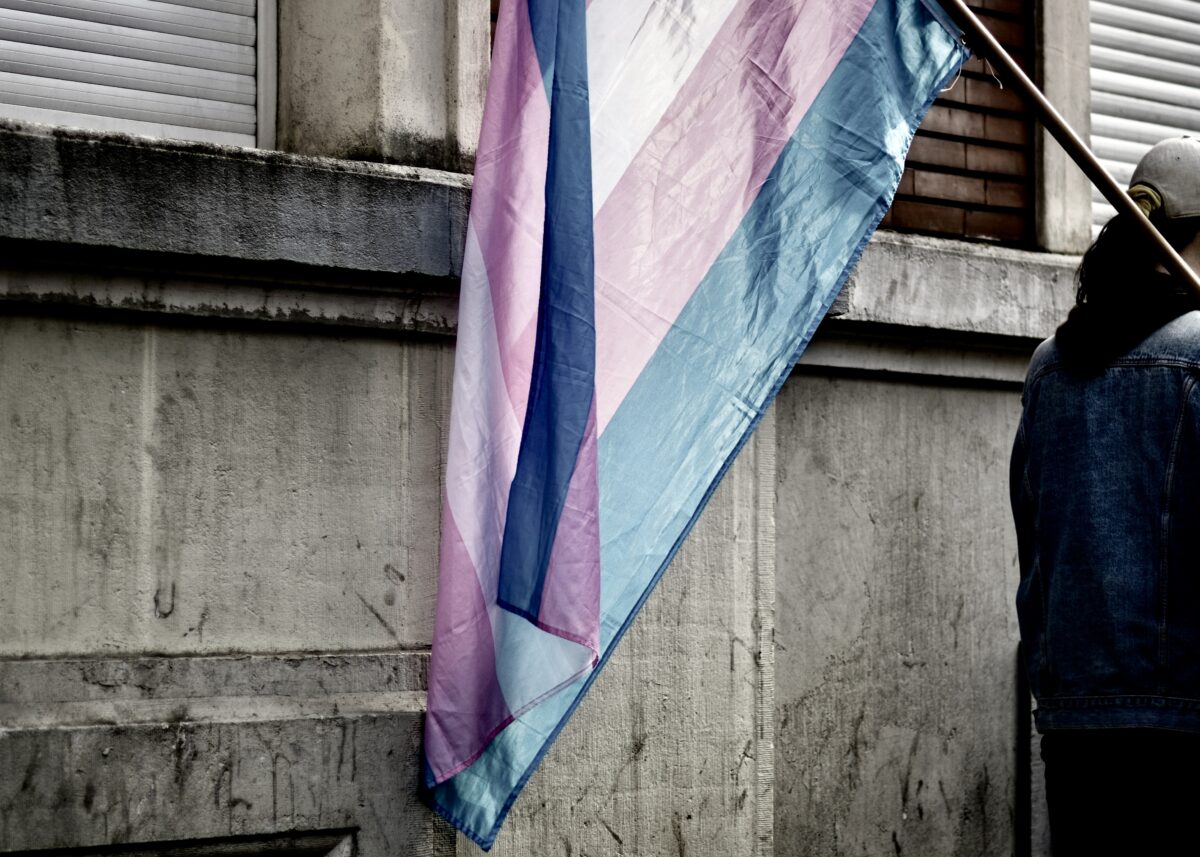
Any time someone in power says, “Those people shouldn’t exist…”
Think twice.
Or maybe you’re like me, and you only need to think once.
Our internal alarms should go off because there are very few solutions to that kind of problem.
Think about it.
What is the solution to the problem of a person’s existence?
You’re getting it.
In recent months, we’ve watched this rhetoric aimed at the Trans Community become more frequent and aggressive.
As trans allies, we know that’s our cue to get to work.
And while there are marches and bumper stickers and proclamations of our acceptance…
What else can we do?
Our role
I believe our most powerful work is done in our relationships where we can make the biggest impact.
My readership tends to be theologically liberal, deeply spiritual, and mostly female, and we often belong to diverse communities.
And many of our loved ones fall on the conservative end of the political spectrum.
This means that we have relationships with people who, openly or not, might be anti-trans or transphobic.
So, my dear trans allies, what is our next move?
To begin the reconciling work in our own little circles of influence.
Small changes add up.
But before we begin, let’s establish the two things most of us are dealing with here:
An education gap and a lack of exposure.
Education gap
More often than you might realize, our conservative friends and family who are transphobic don’t even know what it means for someone to be trans.
In this case, we are the first line of defense.
We can absorb the shock while helping to fill the knowledge gaps.
The unfortunate truth is that our anti-trans loved ones have often been attacked not for their rhetoric, but for their ignorance.
Yes, some have voiced it in condemning ways, but when we pause, take a compassionate breath, and dig a bit deeper, it’s easy to see what lies beneath all of that condemnation…
Confusion.1
Which leads them to ask the wrong questions to the wrong people at the wrong time.
It’s uncomfortable for everyone involved, and it further polarizes the humans on both sides.
This is why we, the trans allies, will be the safe go-between.
Let’s be the first line of defense by playing a role in educating our conservative friends and family.
Let’s help them grow in understanding before they engage with someone and cause pain or discomfort they didn’t intend.
We’ll begin with gentleness, letting what they don’t know lead the way.
People open up to learning when they are safe to be beginners, to express confusion and ask questions.
After all, a full understanding of gender topics can be difficult even for those of us who are trying our best.
We were all beginners at some point.
We will bridge the education gap by starting with the basics.
Here is an example of how I would begin the conversation.
Example conversation
I know it’s hard to talk about these things with openness and curiosity when you feel like you are the enemy.
I’m sorry if I’ve made you feel that way.
I feel strongly about coming to the defense of my trans friends, so I might’ve shut you down without realizing it.
We’re not enemies, and if you’re open to it, I would love to share a few things that I’ve learned that I didn’t know before either.
First, did you know that gender and sex are not the same thing?
Gender is a social construct.
Sex relates to our biology.
When it comes to gender, I’m sure you’ve met people who express themselves in nontraditional ways. We all have that uncle or that friend from high school that didn’t quite “fit the mold.”
What we’re learning is that gender exists on a spectrum that includes masculine, feminine, and non-binary expression.
But gender also varies across time and place.
When you were born and where you live determines what is considered masculine and feminine behavior and identification—see my piece Jesus Wore Dresses for a little more on this.
As for sex, there is male and female biology, but it’s actually not that simple.
What a lot of people don’t know is that there is even a spectrum for reproductive anatomy, everything from your chromosomal make up to hormones to physicality.
I realize this might not be your experience.
You might fall clearly on one side of the spectrum, but that doesn’t mean your experience is everyone else’s experience. We are talking about a minority population that has been widely misunderstood and even condemned for their genetic makeup.
When it comes to both sex and gender, our biological and social identifiers, we are dealing with spectrums, not binaries.
Second, sexuality and gender identity are not the same thing.
Sexuality is about who we are attracted to.
Gender identity is about our sense of self.
When we are discussing the Trans Community, we are discussing gender identity not sexuality.
**This particular distinction is where my loved ones get hung up. Don’t make them feel dumb. Take time here to make sure they understand the difference.
Gender is a moving target that changes based on when and where someone is born.
And how someone expresses gender has nothing to do with who they are sexually attracted to. For example, a trans woman could be attracted to women or men.
Sexuality and gender identity are two separate conversations.
**This is another sticking point. Our conservative loved ones often want to talk about reproductive anatomy when this part of the conversation comes up. This is when we get into the “well, what someone else has in their pants is really none of our business” part of the conversation.
When it comes to sexuality, heterosexual couples engage sexually in myriad ways, but we don’t concern ourselves with that by asking intrusive questions or making assumptions and judgments…
So why do we think it’s any of our business how the Trans Community engages sexually?
It’s not exactly dinner conversation to ask someone about their genitals and what they like to do in bed. Although I guess there are some dinners where these are the exact questions you’re asking, I just haven’t been invited to one yet. #Rude
If you have questions and curiosities, it’s ok to do your research. Who knows, you might even stumble upon something interesting.
But in the same way you wouldn’t ask intrusive questions of a cisgender person (someone whose gender identity corresponds with their sex registered at birth), don’t ask those questions of a trans person.
To summarize:
1. Gender and sex are not the same thing.
2. Gender identity and sexuality are not the same thing.
3. And while you’ve always understood these concepts as binaries, we’re learning that there is a wider variety of expression and experience than we were previously aware of.
Do you have any questions?
In some ways, the ideas above are simple.
In other ways, they are complex.
And as we know, for many, the whole discussion is incredibly confusing.
But I truly believe that many of our conservative loved ones simply need a better understanding of the Trans Community to become allies themselves.
They don’t have to have a full understanding of every point along every spectrum to become an ally.
Lack of exposure
This is where exposure comes in.
When you hear the story of someone who identifies as trans, you will have a reference point for how these spectrums operate.
And you’ll have a soul to tie to your opinions on the matter.
Like Brené says, “People are hard to hate close up.”
If your conservative loved ones have never met a trans person, ask them to listen to their stories.
This is where the internet is such a win.
You can start with this piece from the Pew Research Center called The Experiences, Challenges and Hopes of Transgender and Nonbinary U.S. Adults.
It’s powerful because it tells dozens of first-person stories that allow the reader to gain an understanding of what the Trans Community experiences.
You can also encourage them to watch the following two episodes of the Netflix documentary You Can’t Ask That.
Season 1, Episode 3: Transgender
Season 4, Episode 3: Intersex
These brave interviews offer a vulnerable look into the lives and experiences of marginalized communities that have often been misunderstood because they don’t fall into the traditional binaries for gender or sex.
And while intersex people are not transgender, listening to their stories will increase our awareness of the vast and varied human experiences as they relate to sex and gender. The Human Rights Campaign’s Understanding the Intersex Community is also an excellent resource to learn more.
As your conservative loved ones are exposed to the lives and stories of people who don’t fit cleanly within their prescribed binaries, it will become harder to oppose their existence.
People are hard to hate close up.
Which leads me to a quick (but important) note on compassion with conservatives.
Many of these concepts are simple for us now, but they haven’t always been.
This is the nature of an evolving human consciousness.
In the same way that our consciousness has evolved around religion, slavery, women’s rights, etc., it will evolve around gender and sexuality.
Remember, the state of confusion and condemnation that our conservative loved ones are operating within is uncomfortable, and they want reprieve from this discomfort as much as we want them to move into understanding and, ultimately, acceptance.
We can help them in this process by making space for their confusion while gently confronting their prejudice.
We are all products of our environment, what we’ve had the opportunity to learn, and who we’ve been able to meet. Most of the people I’ve met who are anti-trans have not had these opportunities yet.
Let’s approach them with compassion from this place of understanding and cultivate a more productive, longstanding discussion.
And as we watch the small changes pile up, we’ll find an ally’s greatest ally—hope.
We should all exist.
And when something doesn’t seem to be working, it’s ok to try something new.
Let’s lead with compassion and start fresh by prioritizing education and exposure within our circles of influence.
And don’t be discouraged if progress in these conversations feels slow, after all, that’s how human consciousness evolves.
While the role we play might feel small, over time and across generations, it will add up.
We have a lot of work to do.
Let’s get to it.
End Notes
1. This does not apply to every transphobic person. Many know exactly what it means for someone to be trans, and they are hateful and condemning anyways. I am referring to the segment of the conservative population that operates from ignorance, not hate.